Koh Samui: Evolution of a One Time Paradise
There are so many islands in the south of Thailand that deciding which ones to visit is a nice problem to have. In addition to the top-tier islands on the Andaman Sea side—heavy hitters like Phuket, Koh Phi Phi, Koh Lanta, Railay Beach, Koh Lipe, Koh Yao Yai, and Koh Yao Noi—you have the distinct island archipelago over in the Gulf of Thailand, featuring Koh Tao, Koh Pha Ngan, Koh Samui, Koh Kood, Koh Chang, and a bunch of others.
Earlier on this round-the-world journey, we spent some serious time exploring the Andaman side. Now, it was time to cross over and visit the Gulf of Thailand.
Gulf of Thailand Island Archipelago
The three main islands in this specific gulf chain are all entirely different beasts, each catering to a completely different travel vibe.
[The Gulf of Thailand Island Matrix]
* Koh Pha Ngan ──> Backpacker bars, legendary full-moon ragers, and wellness/yoga retreats.
* Koh Tao      ──> The undisputed scuba diving capital of the region.
* Koh Samui     ──> A heavily developed island loaded with high-end luxury resorts and nightlife.
If you want a more built-up island experience with midrange comforts with ultra-luxurious villas and a nightlife scene, Samui is typically the spot that will set you straight.
However, Barbie and I were both pretty reluctant to re-visit Koh Samui—Barbie even more so than me. We had heard through the travel grapevine just how insanely overdeveloped the island had become. See, Koh Samui happens to be the very first Southeast Asian island I ever set foot on roughly 25 years ago, back in 1991. Back then, it was a simple, dirt-cheap, tropical backpacker paradise. I loved it so much that when Barbie eventually came under the Big Doug umbrella, I was anxious to show her this pristine slice of heaven, so we headed back together in 2002. Even then, I was taken aback by how quickly the infrastructure was growing, but the island still managed to retain some of its original, raw Southeast Asian tropical charm.
Fast forward to our visit on this leg. I just couldn’t resist dropping in to see exactly how the landscape had shifted over the decades. And oh boy, has it changed…..I mean really changed. What was once a sleepy tropical paradise has effectively been transformed into a commercialized tourist clusterfuck. The picture on the bottom left was taken with my friends in the good ole days in 1996 when the island was a true tropical paradise.


Bophut Beach
To preserve our sanity, we opted to stay completely away from the east side of the island, neon circus of Chaweng Beach. Instead, we chose the quieter northern shores of Bophut Beach and booked a stay at a boutique resort called Zazen.
The decor of the place is what I like to describe as “hipster cool chic.” Now, let’s be perfectly honest: I am clearly not a hipster, nor am I the least bit chic. However, I absolutely qualify as being one cool MF, so I decided the Zazen Boutique Resort was a fitting spot for a couple of bad mamma jammas like us to plant ourselves.
The resort itself was real nice, but I wasn’t crazy at all about Bophut Beach itself—the sand and water quality just didn’t blow me away. On the plus side, the property sat close to Fisherman’s Village, which is a fun place to wander through at night. It features a wide range of open-air restaurants where you can eat great meals directly on the sand with the waves crashing a few feet away. Bophut is a great little town to pass through, grab some lunch, and check out while you’re circling the island on a motorbike, but outside of Fisherman’s Village at night, the area is a bit of a zippo with not a whole lot else to see.
Songkran Water Festival
After we wrapped up a side trip to neighboring Koh Phangan, we returned to Samui and deliberately dove straight into the thick of the Chaweng Beach action to get the best experience to celebrate Songkran.
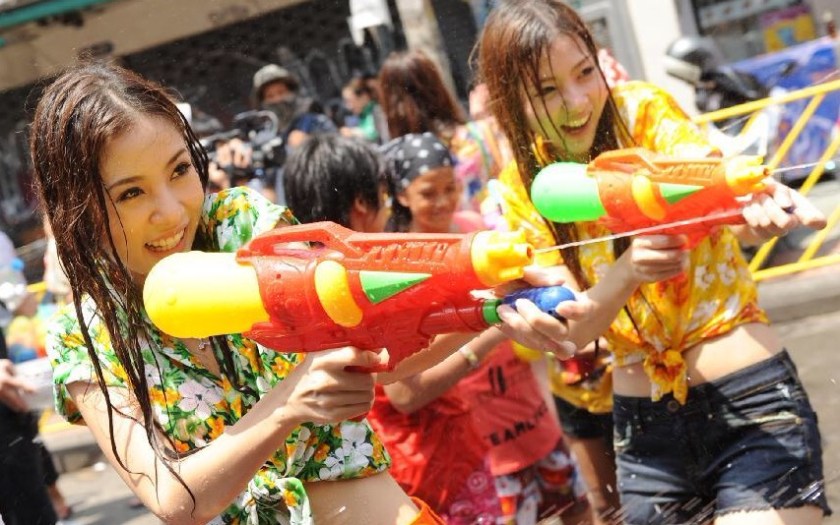
This incredibly fun, chaotic, and completely wild holiday marks the traditional Thai New Year, and it is easily one of the most fun cultural events you can ever catch while traveling. Songkran is essentially the world’s largest, country-wide, three-day-long water fight.
Ten years ago, Barbie and I celebrated Songkran up north in Chiang Mai and had an absolute blast. This time around, we got to experience the coastal version in Koh Samui, where the main beach road transforms into a literal water war zone. Our guns were fully loaded, but so was everyone else’s. I gleefully played the role of a beachside sharpshooter, with my main targets being unsuspecting Chinese tour groups. I loaded icy cold water straight into my high-powered water gun bazooka, aimed right for the eyeballs, and scored some absolutely legendary hits. Of course, live by the sword, die by the sword—both Barbie and I got nailed relentlessly from every angle. We were completely and utterly drenched for three straight days, and it was brilliant.


The Price of Prosperity
🇹🇭 Thailand Update
The Reality of Development: The explosive growth of Koh Samui has definitely altered the raw, pristine tropical charm it possessed decades ago. The main commercial strips can feel like a bit of a tourist factory, where the only locals you interact with are those hawking cheap clothes and souvenirs.
However, looking at this country through a broader lens, Barbie and I have grown to love Thailand all the more. This rapid expansion has morphed the country into a way more advanced, prosperous, and modern nation. The rise of high-priced, beautifully secluded luxury resorts gives flashpackers a stunning level of comfort and privacy away from the central chaos. It’s an amazing place to enjoy top-tier amenities. While we miss the untouched beaches of 1991, we absolutely celebrate Thailand’s current-day prosperity and advancements, which is exactly why we keep coming back to this country for extended stints.
LOOSE STOOLS INDEX
I have been eating a literal ton of the freshest, sweetest local fruit on this island. My daily tropical rotation has been heavily focused on papaya, mango, pomelo, and fresh pineapple. The natural, fiber-rich binding properties of these incredibly healthy fruits have been an absolute net positive for the internal plumbing. The consistency is stellar.
Thru the Binocs
The term “VIP” sounds incredibly posh, right? But what does VIP actually mean when you’re traveling through Asia? You would think it stands for Very Important Person, or something along those highly exclusive lines. Every single local tour agency and transport kiosk allows you to drop a few extra bucks for a coveted “VIP experience.” After all, who the heck doesn’t want to be treated like royalty?
When you are booking bus or ferry trips in Southeast Asia, “VIP” is usually just clever marketing jargon for “this vehicle has functioning air conditioning.” It’s simply a way to entice tourists to book the ticket.
To be fair, it is significantly nicer than riding on a local, non-AC chicken bus. Your extra moolah might even secure you a complimentary bottle of warm water and a crummy meal voucher valid at a dusty roadside rest stop. If you’re lucky, it also includes AC vents strategically stuffed with old tissues to prevent the condensation from dripping directly onto your forehead for six hours.
So, the next time you are navigating Southeast Asia and a ubiquitous travel booking agent tries to hard-sell you on the coveted VIP upgrade package, do yourself a favor and keep your expectations firmly in check. For me personally, after traveling hard through this region for six months, I have come to the definitive conclusion that VIP actually stands for Vomit Inducing Probability.

