Mexico’s Dangerous Reputation:
Between five seasons of Breaking Bad, endless documentaries on El Chapo, and the constant fear-mongering on the news back home about “caravans” of criminals, the media does a real hatchet job on this country. Before Barbie and I crossed the border, I can’t begin to tell you how many people back home were quick to warn us about our impending demise.
Let me tell you right now: it is a total load of malarkey. It’s the exact same nonsense people regurgitated to us before we spent two months in Morocco. After nearly five years of continuous global travel, I’ll tell you straight up that the most dangerous place we ever visit is the good old USA, where I’m always on guard against the sheer volume of clinically insane people wandering the streets.
My advice? Ignore your fellow Americans—especially the ones who have never even set foot in Mexico and are just repeating what they saw on CNN or Fox News. After spending two solid months road-tripping through the states of Yucatán and Quintana Roo, I can confidently tell you this negative reputation is completely undeserved. At absolutely no point did we ever feel unsafe. To the contrary, I was blown away by how relaxed and safe the atmosphere felt everywhere, with families out laughing and enjoying the town squares late into the night.
The Ultimate Yucatan Road Trip Strategy
After a brief stint in Cancún and a week on Isla Mujeres, we locked in our real mission: a six-week road trip deep into the peninsula. The Yucatán is so much more than just the mega-tourist hubs of Cancún, Playa del Carmen, and Tulum. It is prime territory for a good old-fashioned road trip. You could easily spend months out here and still barely scratch the surface.
To do it right, you need to rent a car. Having our own car was a total game-changer because it gave us the ultimate flashpacker advantage: arriving early enough to beat the tour buses to the ruins and cenotes.
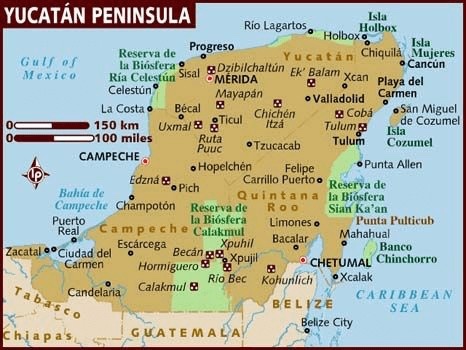
Our itinerary was as follows with many other stops in smaller towns.
CANCUN – ISLA MUJERES – VALLADOLID – IZAMAL – TELCHAC PUERTO – MERIDA – LAKE BACALAR – TULUM – PLAYA DEL CARMEN – COZUMEL
Driving here is relatively easy, but you’ve got to keep your eyes peeled for two things:
- The Topes: Ubiquitous, annoying, axle-breaking speed bumps on every local road.
- Aggressive Drivers: Locals who seemingly take great pleasure in driving right up your ass.
I spent over a month driving through Morocco dodging random goats, donkeys, and camels, so a few aggressive drivers didn’t rattle me. In Mexico, the only road hazards are packs of old-school stray dogs. But they want nothing to do with humans—they’ve got their own shit going on, just like we do.
Our daily itinerary was simple: swim in the cenotes, check out some ruins, gorging on tacos and washing them down with ice-cold chaya juice or horchata rice milk. We planned on experimenting with both the regional Mayan and Mexican specialties. I actually had no idea that traditional Mayan food is completely different from standard Mexican cuisine.
The Cenotes:
A cenote is a natural limestone pit, large holes in the ground filled with crystal clear spring water. These pockets of paradise are truly hidden gems of the earth and are awesome places to swim and snorkel in. They are all spiritually charged places and sooooo freaking magical. The Cenotes scattered across the Yucatan Peninsula were spectacular. You could spend weeks just going cenote hunting. One of our other missions on this leg of our trip besides stuffing our faces with mucho tacos was to swim in as many cenotes possible.
The Ruins:
Checking out many of the renowned archaeological ruin sites (Ek Balam, Chichen Itza, Coba, Uxmal and Tulum Ruins) was also on our itinerary. Many other ruins sites in the Yucatan don’t have any other tourists around. They are everywhere. However, given it’s relative distance and isolation from the more touristy parts of Mexico, nobody really passes through.
Valladolid:
Valladolid is a laid-back colonial town that serves as the perfect hub for some cenote hunting. It even has a massive cenote right in the middle of the city center!
Our favorite daily activity was simply wandering the calles surrounding the main plaza (Parque Francisco Cantón). If you go, make sure to walk down the prettiest street in town, Calle de los Frailes, down toward Sisal Park. In the evenings and on weekends, they pedestrianize this strip of traditional colonial architecture. The historic houses have been converted into chic shops, cafés, outdoor garden restaurants, and boutique inns. Walking down it felt like being on a 1930s movie set—I was genuinely surprised to find such a sophisticated, upscale vibe in this little town.
The main events in Valladolid are the surrounding ruins and underground pools. Here is how they stack up:
The Ruins
- Ek Balam: Small, ancient, and completely lacks the suffocating crowds of Chichén Itzá. As an added bonus, there’s a fantastic cenote right on the property.
- Chichén Itzá: Totally packed with tourists, but it’s a wonder for a reason. J ust make sure you tie it in with a cooling dip at the nearby cenotes to recover from the heat.
The Cenotes
Pro Tip: You must arrive before 11:00 AM. If you beat the tour buses, you will often get the entire cavern to yourself, which completely changes the experience. Once those tour buses begin arriving, way too many tourists will spoil the serenity.
- Cenote San Lorenzo Oxman: A non-negotiable must-visit. Easily one of our absolute favorites, complete with a pool, bar, and food on-site.
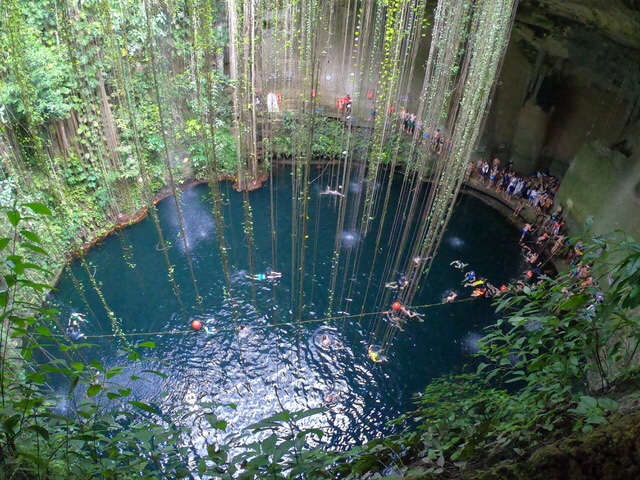
- Cenote Ik Kil: Stunning, but hits peak crowds. Visit before you go to Chichén Itzá.
- Cenote Xcanaché: Right at the Ek Balam ruins. Perfect combo day.
- Cenote Suytun: The famous Instagram spot with the sunbeam platform. Arrive early or don’t bother.
- Cenote Zací: Conveniently located right in the middle of town, though a bit rough around the edges.
- Cenote Chihuan & Cenote Yokdzonot: We didn’t personally make it to these two, but they get rave reviews from fellow travelers—Chihuan is a full subterranean underground cave pool.
Valladolid Food Picks
- La Selva: Our absolute favorite local joint. Awesome food, killer prices.
- Lonchería El Amigo Casiano: An amazing hole-in-the-wall spot tucked inside the local food court.
- Other solid choices: Casa Italia, El Mesón del Marqués, Naino, Ix Cat Ik, and Taberna de los Frailes.


Check out the attached Youtube video of a real diving contest at Ik Kil Cenote, nearby to Chichen Itza. This cenote was really spectacular.


Izamal: The Bright Yellow Gimmick
On our drive from Valladolid to Izamal, we made an executive decision to skip the boring toll highway (Route 180D) and take the local road (Route 180) through the tiny Mayan villages. It was the best call we could have made. It gives you a glimpse into a simple, traditional way of life that you will never see if you stick to the resort strips of the Riviera Maya. Such a different way of life compared to the Caribbean coast. I took note of the simple life in these towns and I wondered what life would be like removed from the modern world. It appeared to have a unique appeal.
What can I say about Izamal? It’s yellow. I mean completely yellow. Every single building in the town center is painted the exact same golden yellow. It’s a brilliant marketing gimmick to attract tourists—much like the famous blue town of Chefchaouen in Morocco—and it creates a highly unique, visual atmosphere.
The strange thing about Izamal……we were practically the only Westerners in town. The locals would look at us with these half-smiles, totally curious, clearly wondering how the hell two flashpackers managed to stumble into their tiny yellow Mayan pueblo.
- Where to eat: Kinich El Sabor de Izamal or Restaurant Zamna for authentic regional flavors.


Telchac Puerto:
There are plenty of beach towns to choose from along the Gulf of Mexico, but unfortunately, the water here is nowhere near as nice as the turquoise Caribbean side. But we knew that going in. We didn’t book our three-night pitstop in Telchac Puerto to lay on the sand; we came to hear the waves crash, eat massive amounts of fresh seafood, and completely cool out away from the busier hub of Progreso.
We took a quick day trip to Progreso to check out their beach scene for lunch and immediately knew we made the right call avoiding it. We happily retreated 30 minutes east to the complete isolation and quiet serenity of Telchac Puerto.
The accommodation we chose absolutely made this stay. We rented a newly built Airbnb right on the sand called Villa Paciencia. It was massive, smack-dab on the ocean, and we had the entire coast to ourselves without a single human in sight. We paid a modest $100 a night for it. If this exact same house were sitting on the Mediterranean or a high-end island beach, it would easily fetch well over $500 a night. There were zero worries and zero hurries here—it genuinely felt like we had reached the end of the earth.


Merida: Big City Life
After the isolation of the coast, rolling into Mérida was a bit of a shock to the system. This is the capital of the Yucatán, and it’s where you find the modern, hip crowd of Mexico. But the amazing thing about Mérida is that despite having a population of a million people, it still feels like a small town. Walk just a couple of blocks off the main drag and you’re suddenly standing on a quiet side street that feels exactly like a sleepy village.
While the city definitely isn’t the prettiest at first glance but those old colonial buildings grows on you.
Surviving the Streets (Offense vs. Defense)
While our rental car gave us total freedom to explore the outlying neighborhoods that tourists never see, driving in Mérida is a challenge. I will go on record and say that navigating the center of Mérida was probably the most difficult driving I’ve done in all five years of our round-the-world journey.
I handled 100% of the driving because Barbie fails to understand the concept of “defensive driving.” Her driving style is all offense and zero defense. I declared myself the sole captain of the wheel, and thank god I did, because negotiating those tight, blind intersections was like playing a high-stakes game of Mexican roulette. I left Mérida with balls of steel, fully prepared to tackle the chaotic roads of Saigon or Bangkok.
Flashpacker Tip: If you don’t want to test your luck with the tight city streets, don’t sweat it. Uber is widely available here and it is dirt cheap—we’re talking Vietnam-level cheap fares.
Splitting the Stay in Merida:
We had eight nights in Merida, so we split the experience. First, we spent four nights at the beautiful Hotel Casa San Ángel, perfectly located right on Santa Ana Square—one of the three main vibrant plazas (alongside Santa Lucía and Plaza Grande) where everyone gathers.
For the other four nights, we hunkered down in an Airbnb tucked deep inside a gritty, authentic local neighborhood where the average tourist would never dream of staying. It felt like we stepped back in time, and we absolutely loved the feeling of being completely off the grid. Right down the block was our favorite neighborhood hole-in-the-wall seafood joint, Restaurante Mar y Sol, which became our automatic go-to spot whenever we didn’t feel like trekking to the center of town.
The Mérida Weekends
The sense of community in this city is unreal. The locals actually come out to partake in massive outdoor cultural events every single week. If you’re in town, don’t miss these:
- Thursday Nights: The Yucatecan Serenade at Parque Santa Lucía. (Get there by 8:30 PM sharp to get a seat).
- Saturday Nights: La Noche Mexicana at the south end of the famous Paseo de Montejo, a sweeping boulevard lined with cafés and restaurants. Afterward, treat yourself to the best refreshing sorbet at Sorbetería El Colón.
- Also Saturday Night: Catch the ancient Pok Ta Pok Mayan ball games held right outside the main square at Plaza Grande.
- Sunday Mornings: The BiciRuta. They shut down the entire main drag of Paseo de Montejo to car traffic, and all the locals flock out to ride bicycles. You can rent a bike right on the street and join the fun.
Out-of-Town Day Trips
Mérida is the perfect base for three awesome day trips:
- The Uxmal Ruins combined with a dip in the nearby, uncrowded cenotes of Dzonbacal, X’batun, and Kankirixche.
- The Cuzamá Cenotes, where you hit three gorgeous cave pools: Chacsinicche, Chelentún, and Bolonchoojol.
- Celestún, a cool coastal biosphere reserve where you can take a boat out to see thousands of wild pink flamingos.
Big Doug’s Merida Dining Guide
Eating our way through Mérida was the absolute highlight of the stop. Here are some of our favs:
Sit-Down Dining
- La Chaya Maya & Manjar Blanco: authentic Yucatecan and Mayan specialties.
- Apoala: excellent high-end culinary spot in Santa Lucía square.
- Other great spots: Amaro, Catrín, Los Trompos, and La Tratto Santa Lucía.
Tacos, Tortas, and Hole-in-the-Walls
- La Lupita (inside Mercado Santiago): This is a mandatory Sunday morning ritual for the best cochinita pibil.
- Wayan’e: Legendary local taco institution.
- Mercado 60: A fun, upscale outdoor food court vibe.
- Cafetería Impala: An iconic diner spot right on the Paseo de Montejo for people-watching.


Thru the Binocs: The Final Verdict on the Yucatan
Food plays a massive role in how we judge a country. Mexican food happens to be Barbie’s absolute favorite ethnic cuisine, and she is totally game to crush a carne asada taco at any hour of the day—even for breakfast. Now that is hardcore.
We are officially five weeks into this Mexican journey, and I can honestly count on a single hand the number of bad meals we’ve had. I’m going on the record right now: Japan, Thailand and Mexico have the most flavorful food of any countries we have ever visited on this round-the-world journey. (Morocco is right up there too, but let’s face it, the depth of options gets a bit limited once you get tired of eating the ubiquitous tagine every single day).
In summary, we absolutely loved our time road-tripping through the Yucatán. Because we are lucky enough to have unlimited time for our travels, the pressure to hit only the famous tourist traps completely fades away. Getting off the beaten path and into the smaller towns and villages where not a single lick of English is spoken is easily the most rewarding aspect of travel.
Queuing up with the locals at the neighborhood supermarkets, eating at the central market stalls, and grabby an early morning coffee without a single other tourist in sight—that is precisely what made this road trip so special.
VIDEO OF OUR FAVORITE CENOTE VIDEOS – (YUCATAN)
 Big Doug & Barbie Drop Out of Society
Good for you, Barbie & Doug!
LikeLike
I had no idea of the majestic beauty of the Mexican peninsula! Absolutely beautiful!! You visited the place I would love to see — Chichen Itza — and I’m envious! Perhaps in my next life . . . Enjoy!!
LikeLike
2 down for us and more to go. we could do this trip no problemo and we have a spanish speaker.
LikeLike