Inle Lake / Nyaung Shwe:
The main gateway for visiting Inle Lake is a small, relaxed town called Nyaung Shwe. The town itself is completely rustic with a great small-town feel. Inle Lake is the country’s second-largest lake, and it’s a highlight—featuring floating villages, floating gardens, various local tribes, and the famous fishermen who row with their legs. It’s a beautifully scenic area and an absolute must-see on any Burma itinerary.
What I enjoyed most about the relaxed pace in Nyaung Shwe was just being able to grab a bicycle, ride around the town and surrounding neighborhoods, and take in the colorful daily scene. While pedaling around, I did notice a ton of small hotels currently under construction. The writing is officially on the wall: Nyaung Shwe and Inle Lake will inevitably be flooded with tourists in short order. I’m just incredibly glad we were able to visit this little gem now before the floodgates completely open.
$14 for Nine Hours on the Water
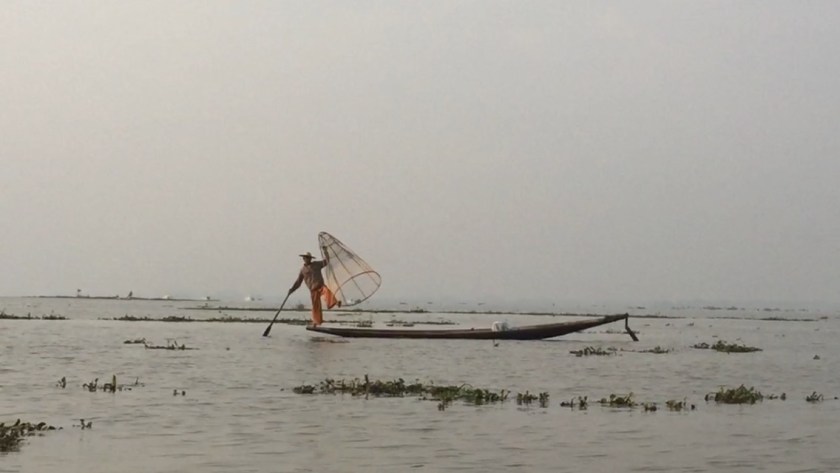
The lake stretches about 25 kilometers and is surrounded by roughly 500 villages. The big ticket activity here is hiring a wooden longtail boat for the day to check out the floating markets, temples, stilt-house villages, and those iconic “one-legged” fishermen doing their thing old-school style.
The fishermen balance flawlessly on one leg at the very edge of their narrow wooden canoes, using their other leg to paddle the boat. This leaves both hands completely free to cast their massive nets. How they manage to balance like that is a pretty amazing feat, considering Big Doug could barely balance standing up in the middle of a wide wooden longtail boat.
We thoroughly enjoyed seeing how everyday life is carried out on the water. The lake is where the local kids play, people bathe, do their laundry, and wash everything from water buffaloes to motorbikes. It was an eye-opening insight into rural life and arguably one of the top day trips of this entire journey—all at a grand cost of $14 for a private boat for nine hours. You just have to love the value in Myanmar.
Biking Outer Villages vs. The 3-Day Trek
While the boat trip is the most popular way to explore, this area deserves more than just a single day on the water. A bike ride is another fantastic way to see the terrain. We spent a full day cycling through the local villages on the outskirts of town and had a blast. The locals are super friendly and incredibly welcoming. Everyone yells hello, and sometimes when we roll through, it’s as if the children think they’ve seen actual ghosts.
You can bike much further afield around Inle Lake, passing right by massive rice paddy fields, canals, stilted villages, hot springs, colorful markets, and even a local winery. We were originally on tap to do that full-day bike trip, but I came down with a rough cough and a sore throat that absolutely kicked my ass. I didn’t want to press my luck, so we dialed it back.


The other massive activity in this region is the hike to get to the lake. Kalaw is the typical starting point for a famous three-day trek through the mountains to Nyaung Shwe, covering about 50 kilometers to the east. It’s highly popular with travelers and gets rave reviews. However, my three-day, overnight, roughing-it hiking days are officially over. Without an ounce of enthusiasm on my part, there was no way in the world I was going to sell Flashpacking Barbie on that idea. We hard passed and opted for a scenic hike to a $6-an-hour massage parlor instead.
Flashpacking Economics & Overpriced Sheets
We really loved Inle Lake. We especially got a kick out of the highly creative names of the two hotels we stayed at: Hotel Brilliant and Amazing Hotel.
So far, the guest houses and hotels in Myanmar have been genuinely good, but they are way overpriced for Southeast Asia. For example, a room that would normally run you $40 to $50 in other neighboring Asian countries goes for $70 to $100 out here. It hasn’t been a complete surprise, as I knew going in that the current hotel supply in this country is severely lacking. As tourism continues to grow at this rapid pace, supply should eventually catch up with demand. At least that’s what they taught me in Economics class back in college—one of the very few things I actually retained.
As flashpackers, we also experienced our very first hotel turndown service of the trip in our most overpriced room yet. Let me tell you, turndown service is a total crock of shit. It’s just one of those luxury hotel gimmicks that I don’t get, don’t want, and don’t need. Just give me a comfortable bed and leave the room alone.
The real, undisputed value in Myanmar is the food. Two people can eat like absolute kings for about $10, and it is some of the tastiest cuisine in all of Southeast Asia. I will gladly go on the record right here and say we have had some of the best meals of our lives right in Nyaung Shwe.
LOOSE STOOLS INDEX
- Rating: 6 / 10
The index took a bit of a hit. My over-indulgent gorging on the local Shan noodle soup—with its intense array of rich native spices—has taken a minor toll on the plumbing. Life is just way too short to deprive oneself of multiple daily bowls of that glorious soup.
Thru the Binocs
The mysterious smell of mothballs continues completely unabated out here.
The other day, an older Burmese lady briskly walked right past my table while I was slurping down my Shan noodle soup. This completely overpowering, pungent wave of mothballs shot straight through my nostrils and entirely overwhelmed my taste buds, briefly disrupting my entire noodle experience.
But looking through the glass, I have finally narrowed down my final mothball conclusion: the Burmese are not actually using mothballs as a weird perfume of choice. It’s their clothing that completely reeks of it.
Because the country is so humid and homes are rural, they must store all of their clothing, linens, and fabrics in heavy mothballs to protect them. Even the fresh bath towels and pillowcases in our hotel smelled heavily like mothballs—and keep in mind, I was staying at a classy joint costing a cool $60 a night!
I have officially stopped fighting it. I’ve begun to accept the smell of mothballs and have even learned to appreciate it as part of the atmosphere. As a nomadic traveler navigating these changing countries, absolute acceptance of the wacky local quirks is a vital trait to possess.
We are now off to the coast. I am incredibly excited to visit Ngapali Beach, as it’s a completely fresh beach area in a country that is mostly off the radar of the massive tourist herds. That in itself sounds highly appealing. I will provide all the beach scoop in my next post.
 Big Doug & Barbie Drop Out of Society