Tel Aviv:
We arrived at the airport in Lisbon for our departure to Tel Aviv with plenty of time to spare. Before heading out, we’d been warned that the local Lisbon taxi drivers were out in force blocking the airport entryways, absolutely pissed off at Uber and wanting them flushed out of the city.
Look, we’ve been traveling the world for the past 13 months, visiting over 50 cities in 13 different countries. If there is one universal, undeniable truth I’ve learned on this journey, it’s this: most all taxi drivers everywhere are complete dirtbags.
Actually, let me go a step further—anybody involved in the local transit hustle around the globe has completely perfected the art of the scam. That goes for Tuk Tuk drivers, Cyclo drivers, Rickshaw drivers, Songthaew drivers, Jeepney drivers, Chicken Bus drivers, Ferry drivers… the list is endless. The absolute last thing you want to deal with after a grueling international flight is having to haggle with these thieves just to avoid getting ripped off. With Uber, there’s no haggling and no scamming, which is exactly why the local cabbies are sweating bullets. Their gig is officially up, and I couldn’t be happier about it.
Interrogation Rooms
The check-in process in Lisbon for an Israeli-bound flight was a completely different animal than what we’ve grown accustomed to. Before you even get near a bag drop, every single traveler is greeted by their own personal airline security representative for a barrage of highly detailed questions.
The stern Israeli female agent assigned to Barbie and me ran off a rapid-fire string of inquiries with total laser focus:
-
“Why are you going to Israel?”
-
“Do you know anyone in Israel?”
-
“Where exactly are you staying?”
-
“Did anybody give you anything to bring into the country?”
-
“Did you pack your own bags?”
The only thing she left private and didn’t interrogate me about was the structural integrity of my bowel movements prior to boarding… which, as it happened, were looking quite solid.
Apparently, we gave all the right answers. We didn’t win a Ford Pinto, but we did score a little coded sticker slapped onto the back of our passports written entirely in Hebrew. I can’t read a lick of Hebrew, but I’m assuming it said something like: “These two Flashpackers are clear. Give them the green light to enter the homeland and gorge on endless amounts of Hummus and Shawarma.”


Yom Kippur in Tel Aviv
We landed in Tel Aviv early in the morning on the eve of Yom Kippur. Experiencing this high holiday right here in Israel turned out to be one of the most unique spectacles of our entire 14 months on the road.
Hours before sundown, the outdoor Carmel Market was absolutely buzzing at a chaotic pace. I figured the locals were either stocking up on massive amounts of food to survive the impending fast, or they were secretly laying out a meticulous game plan to cheat on it.
The big activity I had read about and planned a full week in advance was renting bicycles to cruise around Tel Aviv during the eve and day of Yom Kippur. Back in the States, you’d think riding a bike on the holiest day of the year would be a major religious no-no, but over here, it’s the exact opposite.
During Yom Kippur, there is absolutely zero motorized vehicle traffic on the streets. No cars, no buses, no taxis—nothing but empty roads. Not a single shop or restaurant is open. Luckily, I pulled the trigger on booking our bikes early, because they were completely sold out across the entire city. It turned out every single person in Tel Aviv had the exact same playbook.
The second the sun went down, tons of locals hit the major highways and side streets on bicycles, skateboards, and rollerblades. Crising around Tel Aviv without a single moving vehicle to worry about was an absolute dream and a killer way to map out the city’s layout. The local kids were having the absolute time of their lives clowning around and riding down the middle of empty four-lane boulevards.
Those who weren’t on two wheels spent the day completely taking over the beaches. Even the Israeli dogs got a holiday pass! The strict “No Dogs on the Beach” rule is completely suspended for Yom Kippur, and the local pups were out in full force, chasing each other in the sand and playfully brawling in the Mediterranean surf. A local told me it’s normally a $150 fine if a dog gets caught on the sand any other day of the year, so even the dogs get cut some slack on judgment day.


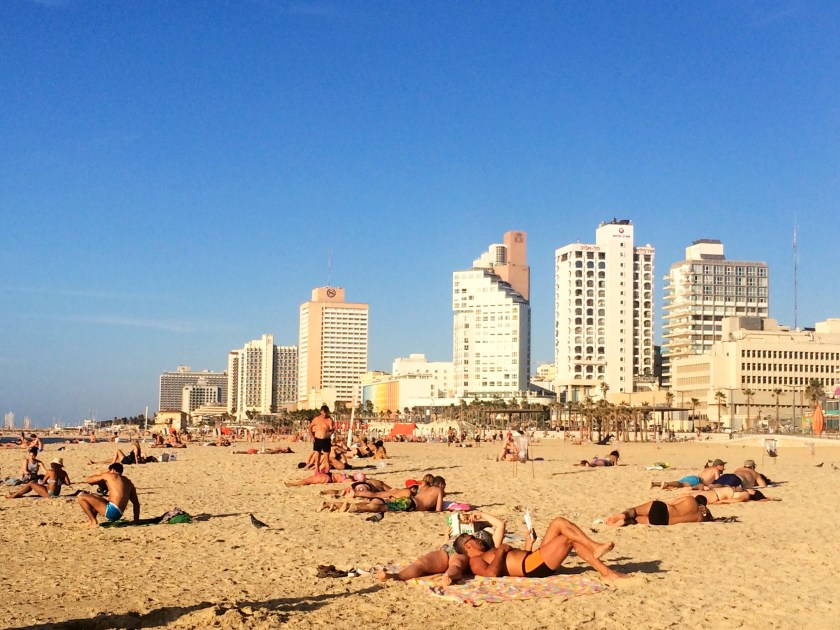
I’ve mentioned before on this blog that I have seen very few truly clean, impressive urban beaches in my life—the only ones that ever made the cut were in Sydney and Barcelona. Well, you can officially add Tel Aviv to that elite list. The beaches here are first-rate and constantly buzzing with energy. The second the sun dipped on Yom Kippur day and the official fast concluded, the entire city promenade instantly flipped a switch, restaurants threw open their doors, and a massive beachside party erupted out of nowhere.
My childhood memories of Yom Kippur back in New York were the complete, polar opposite of this lively Tel Aviv block party. Growing up, I just remember Yom Kippur being a total drag at Temple Ohr Torah—attempting to fast and failing miserably by noon, being bored to death by Rabbi Jungreis’s long-ass sermons, and mingling with fellow congregation members who mostly had atrocious breath because they hadn’t eaten or brushed their teeth all day.
Celebrating in Tel Aviv was a revelation. It was lively, active, and fun. We had a blast riding through empty streets on our bikes, hanging out on the sand, and the best part? We didn’t spend a single nickel all day because there was literally nothing open to spend money on. It just reconfirmed my lifelong theory: the absolute most fun things in life are free.
The Undisputed Hummus Heavyweight Champion
We spent a full week in Tel Aviv, which was the perfect amount of time to knock out the major sights and map the local market circuit (Carmel, Levinsky, Sarona, Hatachana, and Jaffa). Most importantly, we ate the absolute best hummus of our entire lives.
It was a close call, but the undisputed, heavyweight crown champion of kick-ass hummus goes to Abu Hassan in Old Jaffa.
[Abu Hassan Dining Strategy]
1. No small talk. No pleasantries. Walk in with a mission.
2. Order the warm, legendary hummus immediately.
3. Mop it up with fresh pita while waiters yell instructions.
4. Leave by 3:00 PM or the doors are locked. Game over.
Let me tell you, there is absolutely no bullshitting and no polite small talk inside this joint. The locals eating here are on a strict, transactional mission, aggressively mopping up warm bowls of legendary hummus with fresh pita bread. I especially appreciated the screaming waiters and the frantic manner in which the food was served—or more accurately, thrown onto our table. It’s a down-and-dirty, high-speed culinary feast. And remember: when they run out of fresh hummus for the day (usually around 3:00 PM), it’s game over and they shut the joint down. Don’t show up late.
The Tel Aviv Lifestyle
The lifestyle in Tel Aviv is spectacular. It’s vibrant, lively, modern, and positioned right on a gorgeous sea. Honestly, I think every traveler needs to experience it at least once.
What makes the city feel so incredibly comfortable and easygoing is the powerful sense of harmony among the people. There’s a distinct, unpretentious “we’re all in this together” attitude, and locals seem to sincerely look out for one another. I’m just guessing here, but I bet that deep community bond is a direct byproduct of the core values instilled in them during their mandatory military training. It’s a social harmony that looks very similar to what I observed throughout Southeast Asia last year.
Spending all this time moving through foreign countries has revealed a clear pattern outside the United States: people outside of America just seem to have a much more relaxed, content attitude toward daily life. The American corporate obsession with “wanting it all” and keeping up with the Joneses doesn’t carry the same weight out here. There’s nothing wrong with wanting nice things, but our travels have proven that you don’t need a lavish, high-maintenance lifestyle to be completely content.
The Flip Side of the Coin: Now for the Tel Aviv negatives. Visually, the city is old, and a lot of the architecture is honestly pretty ugly. Even after walking through the preserved Bauhaus buildings in the upscale Rothschild Boulevard district—one of the most expensive zip codes in the city—I left completely unimpressed. A vast majority of the buildings spread throughout the grid look like stained, weathered cement blocks, and I was shocked by the sheer volume of graffiti tolerated on them in a country with such stringent national security laws. If you took away that world-class stretch of beach, you’d essentially feel like you just landed in a gritty, concrete Middle Eastern metropolis.
However, there are massive, modern high-rises under construction all along the beach promenade that are slowly giving the skyline a much-needed facelift. The other major downside? The cost of living is sky-high. Everything out here is expensive, so make sure to bring a massive sack of shekels, because every business in Tel Aviv is doing its absolute best to get their hands on yours.
The Official Big Doug Loose Stools Index
🚽 Loose Stools Index: 9.2/10 (The Premium Pre-Flight Concrete)
The stools entered Tel Aviv completely solid, providing a perfect, high-performance foundation to handle the incoming deluge of heavy chickpea pastes, raw garlic, and street market shawarma.
Thru the Binocs: The Israeli Operating Hours Roulette
One major quirk I noticed across the European cities we hit—and one that applies heavily to Tel Aviv—is that local business owners tend to do whatever the hell they want, whenever they want to do it. Store and restaurant owners get away with an unbelievable amount of scheduling randomness. You practically have to be a certified mind reader to figure out Israeli operating hours.
Back in the United States, we have a little thing called “posted business hours” clearly taped to the front window. Here’s how the retail philosophy seems to work down in Tel Aviv: the shop owner wakes up in the morning, stretches, and asks themselves two simple questions: “Should I bother opening the shop today? Or do I prefer to just sit on my ass instead?”
In Israel, they have the ultimate, built-in structural excuse with the never-ending rotation of religious holidays. Consider yourself officially warned: if you plan a trip to Israel in October—which is the peak of the Jewish high holiday calendar—you are entering a total crapshoot if you want to get your lips on some tasty local food. The weekly schedule goes a little something like this:
-
Yom Kippur? Let’s close.
-
Shabbat? Let’s close.
-
Sukkot? Let’s close.
-
Simchat Torah? Eh, not a massive holiday, but let’s be consistent and just close anyway.

