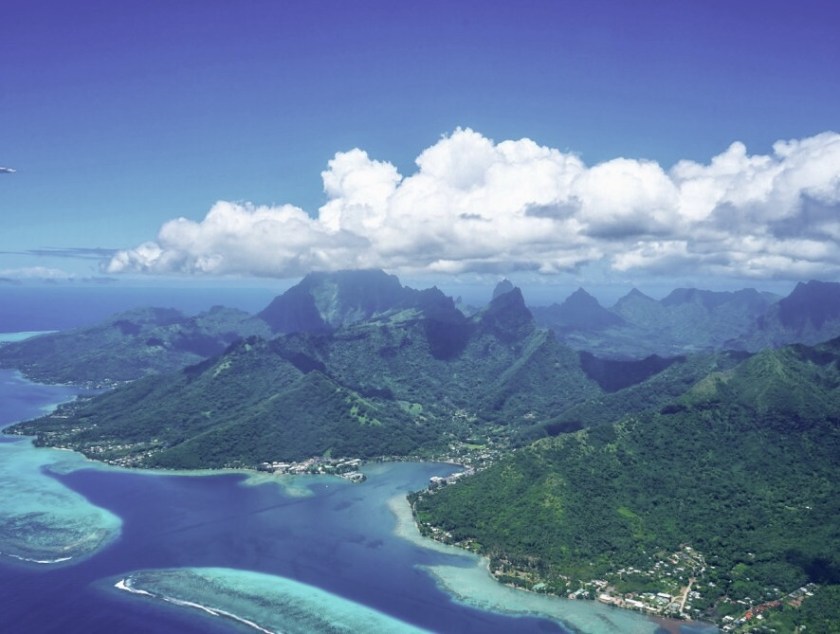
French Polynesia: Fifty Shades of Blue
French Polynesia is made up of 118 islands and atolls scattered across a slice of the South Pacific the size of Europe. When most Americans talk about this part of the world, they usually just call the whole thing “Tahiti.” That is totally and absolutely incorrect. Tahiti is just one single island in the mix.
When I was young and just Doug—well before the days of being Big Doug—I dreamed about French Polynesia for as long as I can remember. But the place is well known to be a brutal, wallet-crushing luxury travel destination. It regularly tops the charts as the most expensive honeymoon spot on earth.
These lush resorts know they have these newlyweds by the balls. They are absolute wizards at extracting every dollar, euro, and pound possible from guests lounging in overwater bungalows. You sit there, completely mesmerized by the sheer beauty of the lagoon, under a unique Polynesian spell, while the staff happily clean you out: “Another $25 USD for a Piña Colada, sir? I can just put it on your tab that you are sure to vomit on when you see the final bill at checkout.”
But if you’re a tiny bit savvy, that is not how it has to go down. To circumvent getting our asses handed to us, us flashpackers were determined to see if we could conquer a bunch of these islands on a moderate budget, far away from the standard package tourists. I am happy to report: mission accomplished.
[Resort Trapped]  ──> $25 Cocktails + $1,500/night bungalows = Financial Ruin
[BFD Method]  ──> Local Pensions + Grocery Cooking + Beach Bikes = Flashpacker Win
Once I realized the easiest and least expensive way to get to Tahiti from our side of the world was via New Zealand, I was forced to pull the trigger. How could I possibly pass on this tropical paradise just south of the equator—the sun’s absolute favorite residence? French Polynesia is basically the center of the romantic universe. I had to see if BFD could polish up his nicest flip-flops and morph into Romantic Big Doug for a few weeks.
For years, I’d been listening to the Crosby, Stills & Nash song, “Southern Cross,” which is all about sailing around these waters, and I had to see what the boys were singing about. The sheer beauty of these islands is almost impossible to overstate. I might go down as the shittiest iPhone photographer in history, but the scenery does all the heavy lifting.


Tahiti:
Every international traveler arriving in French Polynesia lands in the port city of Papeete on the main island of Tahiti. Very rarely do tourists spend more than a single night here; they immediately use it as a transit point to flee to the outlying islands like Bora Bora or Mo’orea. Most people skip it because it lacks sweeping white sand beaches and has a very rough-around-the-edges appearance. If you are a clueless traveler who simply books a blind ticket and stays exclusively in Papeete, you will be sorely disappointed and go down as dunce of the year. But if you have the time to set aside a full day to drive the entirety of the island, you will uncover the real, authentic Tahiti. Just make sure that day isn’t a Sunday, because Sunday is an absolute “dark day” of rest on the island.
Even though I knew going in that French was the official language, I had no idea that barely anyone on Tahiti would speak or understand a lick of English. In all of our global travels—including the deepest backwoods of Southeast Asia—English has been widely spoken. Tahiti was hands down one of the most difficult places to communicate. Coming off five months in Australia and New Zealand where communication was as simple as, “I’ll take a steak and cheese meat pie, mate,” it was back to basics for us. Finger-pointing, intense eye contact, exaggerated body language, and breaking out Google Translate like you’re speaking like an infant all had to come back into play.
At first glance, seeing local islanders in board shorts, flip-flops, and no shirts, the last thing you expect to hear rolling out of their mouths is fluent French. It honestly reminded me of my old Camp Echo Lake kitchen-working days. A guy from London arrived for his first day to scrub pots for the summer, and I will never forget the bewildered look on the Kingpins face (who is from Brooklyn, NY) when he realized the guy scrubbing the pans possessed a thick, aristocratic British accent. It’s just wild hearing dark-skinned tropical islanders speaking French.
For the mostly French white tourists and residents, Tahiti is like their own private enclave in the middle of the South Pacific—an oasis where they can stick their middle finger up to the entire English-speaking world. Arriving here felt exactly like that scene in Apocalypse Now where Martin Sheen first arrives to see Colonel Kurtz in the jungle. Simply trying to decode the place and its people was one big puzzle.
The Ultimate Poisson Cru Obsession
Papeete has the grit of a third-world port city, on par with a place like Yangon, Myanmar. We loved the vibrant atmosphere during the day but it got kinda eerie at night. While exploring the city, we hit up the local market, which was colorful and where I inhaled a massive amount of the freshest, reddest tuna sashimi.
But the real crown jewel of French Polynesian cuisine is the signature dish: Poisson Cru (known locally as ’Ōta ’ika). Anytime we weren’t eating Flashpacking Barbie’s home cooking, we were scoffing down this stuff. It became our absolute go-to food. Every single roadside shack serves up its own version, and no two recipes ever tasted the same.
The Poisson Cru Blueprint:
[Raw Cubed Tuna] + [Lime Juice] + [Fresh Coconut Milk] + [Shredded Veggies]
It’s a raw fish salad consisting of fresh tuna flash-marinated in lime juice (which cold-cooks the fish) and mixed with rich coconut milk, shredded carrots, tomatoes, cucumbers, and onions. It’s similar to Hawaiian poke, but this dish completely destroys poke due to the depth of the fresh coconut milk and lime combination. It comes served with white rice or a freshly baked French baguette, which a professional Poisson Cru eater uses to sop up every last drop of leftover coconut milk from the bowl. We are talking some seriously tasty shit here. We were hopelessly addicted.


To explore the island outside of Papeete, we rented a car. Well, calling it a car is a stretch—it was the smallest, most underpowered piece-of-shit rental vehicle on planet earth. To make matters worse, it was also the most expensive car I’ve ever rented at a steep $75 USD a day. Everything geared toward tourists here is absurdly expensive. Case in point: a local SIM card for our iPhones cost a whopping $100 USD for a pathetic 3 gigs of data, easily topping Israel for the most expensive data we’ve encountered on our travels. I guess the silver lining was that it forced us to keep our eyes off our phones and on the landscape.
To beat the high restaurant prices, we discovered that at 6:00 PM every night, about a dozen les roulettes (food trucks that operate like full-service outdoor kitchens) gather at Vai’ete Square downtown. They serve up massive portions of local food, grilled meats, and raw fish at very reasonable prices. It turned a budget-conscious dinner into a festive, open-air experience hanging out with the locals.
Cruising the island in our rolling shit ass car, we took in massive waterfalls, hidden viewpoints, and deep interior hikes. What I enjoyed most was simply observing the locals going about their daily business in villages far away from the city center, showing just how simple and content life can be. Tahitians live in paradise, and while the average salary is incredibly low, the people are easily among the nicest and happiest I’ve ever met.


Bora Bora:
The flight over from Tahiti to Bora Bora was a masterclass in aviation beauty. I always prefer nonstop flights, which in this case should have taken a direct 30 minutes. Instead, our island-hopper routing had two scheduled stops on other islands with no change of planes: Tahiti to Mo’orea (10 minutes), Mo’orea to Huahine (30 minutes), and Huahine to Bora Bora (30 minutes). When I first saw the itinerary, I thought to myself, WTF, how does a 30-minute flight have two stops? Well, after taking what could easily go down as the most scenic flight in the history of aviation, I would have happily stayed on that plane all day. The low-altitude views over the coral reefs and lagoons were spectacular—like something out of a dream.
When friends back home say they’re going to Bora Bora, I don’t think they realize that they aren’t actually going to the mainland of the island. Instead, they are staying on the tiny motus (sand atolls) that encircle the main volcanic peak. Those smaller motus are home to all those pimped-out overwater bungalows sitting on stilts above water so brilliantly blue that only the Kool-Aid brand could duplicate it. Those rooms command anywhere from $1,000 to $15,000 USD per night. At that price tag, a Tahitian princess with colorful flowers wrapped around her head better be coming into my room every day to juggle my balls and serve me fresh drinks while I lounge in a hammock.
Since $1,500 a night is an absolute no-go for us flashpackers, we opted for a completely different experience. We shacked up at one of the alternative local pensions (guesthouses) that dot the main island where the actual residents live. We scored a sweet one-bedroom apartment with a full kitchen and a massive balcony right across the street from the lagoon. Staying here enabled us to cook our own meals and experience what real island life feels like.
Our crib was a quick five-to-ten-minute bike ride from Matira Beach, which is widely considered the absolute best stretch of sand on the island—the exact same water that guests overpaying at the nearby InterContinental Le Moana are frolicking in, except we were doing it for a fraction of the cost.
The absolute must-do activity here is a lagoon cruise where you jump into the water to snorkel with wild reef sharks and massive stingrays in water that possesses about fifty shades of blue. As the boat circled the lagoon, we got to peer through the binoculars at the big-kahuna overwater bungalows at the Four Seasons, St. Regis, and Le Méridien. Oh boy, do those bungalows look sweet if you are a certified high-roller with the bankroll to match. Bora Bora is an elite, special place. It’s seriously gorgeous—like blow-your-mind, life-altering gorgeous where you constantly feel like you’re walking through a Photoshopped world.


Huahine:
Our next stop was Huahine. It is a tiny, incredibly wild, and sparsely populated island that sees very little tourist traffic. It’s not all that surprising, because let’s honest: have you ever even heard of Huahine? I know I hadn’t until I started mapping out this trip. I read a handful of reviews calling it the ultimate hidden, wild gem of the Society Islands, and that was more than enough to get me to book a ticket.
Visiting Huahine is like stepping completely back in time. Hopping on a bicycle and riding the gravel paths felt like we were on our own private jungle island. I never thought I would see more vibrant shades of green than we did during our recent road trip through New Zealand. But the 20-mile loop around the circumference of Huahine—which is a mandatory drive if you visit—took the color green to a level I didn’t think existed on the spectrum, with the possible exception of Snoop Dogg’s house. We drove down to the south side of the island to a local spot called Chez Tara to feast on some awesome Poisson Cru (Tara absolutely knows her shit when it comes to whipping up the raw fish), followed by a long dip in the completely empty blue lagoon right in front of the restaurant.
Living on Gilligan’s Island
When traveling long-term, you occasionally get lucky enough to stumble into a truly unique, rustic accommodation, and we found exactly that at Rande’s Shack. The property overlooks the lagoon facing the neighboring islands of Raiatea and Taha’a, making for some damn impressive, uninhibited sunsets. It’s also a convenient two-minute bike ride into the main village and sits right near an incredible stretch of beach.
It took a day or two to adjust to the setup at the Shack because it genuinely felt like we were living on the set of Gilligan’s Island—minus the creature comforts that the millionaire and his wife probably brought along. We had zero AC in heavy tropical weather, crummy shower water pressure, and absolutely no TV or internet. Rande’s local island dogs, Blackout and Boy, freely roamed the property alongside a flock of wild chickens and roosters, who honestly never ate so well after Flashpacking Barbie finished feeding and spoiling them all week.
We loved it. You couldn’t ask for a more rustic, authentic, or localized tropical living experience. It provided the most remote, disconnected feeling we’ve experienced in all our world travels. Barbie and I spent hours floating in the lagoon waters in front of the Shack without seeing another living soul in sight. This island was the absolute exclamation point of dropping out of society.
There is virtually no tourism infrastructure on Huahine and no major corporate hotels. It is an island designed for a total mental reset. My heart rate was already flatlining after our relaxed stay in Bora Bora, but this place induced a level of comatose relaxation that I didn’t know my body was capable of achieving. If Tahiti represents speed, then Huahine is pure Valium with a Quaalude chaser. People who live here are never in a hurry to do anything. If you’re a high-strung, type-A American accustomed to a barista whipping up your complex chai latte in two minutes flat, Huahine will test your sanity. Gotta learn to slow it down.


Mo’orea:
Our final island stop was Mo’orea, and it had to be something spectacular to top what we experienced on Bora Bora and Huahine. Well, Mo’orea delivered on a massive scale.
As soon as we picked up our rental car and hit the road, Barbie and I just looked at each other and smiled. Instantly, we knew this place was going to be something special. The towering, jagged green volcanic peaks that surround you as you drive around the perimeter are really awesome. The landscape is easily as dramatic and impressive as driving through Zion National Park. But while Zion features massive golden and red sandstone cliffs, Mo’orea’s jagged peaks are painted a lush, tropical emerald green, heavily resembling the dramatic Na Pali Coast of Kaua’i.
We have laid eyes on a shitload of islands during our round-the-world journey, but the sheer magnitude of Mo’orea’s raw nature easily takes first prize as the most kick-ass island of the bunch.
Flashpacker Tip: Renting a vehicle is an absolute must if you want to properly see the entirety of both Mo’orea and Huahine. Just make sure you know how to drive a stick shift—automatic transmissions are practically non-existent on these outer islands. Tahiti has a few in stock if you beg, but out here, it’s manual transmission or bust (unless you’re on Bora Bora, where a simple bicycle is all you need assuming you’re in decent physical shape).
We originally considered skipping Mo’orea because I had the false impression it would be a commercialized, over-tourism honeymoon hub. I am so glad we corrected that error. We spent our days beach-hopping around the island, pulling our manual car into various roadside shacks to get our daily fix of fresh Poisson Cru.
The single biggest challenge while driving here was keeping the car on the road and not crashing into the ubiquitous roadside papaya and pomelo stands, because your eyes are constantly glued to the mountain peaks in an ongoing state of “Holy shit, goddamn!” awe. Barbie and I have spent a lot of time living on the Hawaiian islands, and what we appreciated most about French Polynesia is that it is significantly rougher around the edges. We loved seeing the traditional Polynesian architecture, smelling the damp island air, and witnessing everyday local life completely intact. We kept imagining that this must be exactly what Hawaii looked like 50 or 60 years ago, well before the arrival of massive commercial development and concrete mega-resorts.


Thru the Binocs:
During our three weeks island-hopping, we actually overlapped with Barack Obama’s high-profile stay on the nearby private atoll of Tetiaroa. The former President was holed up looking for complete isolation while drafting his presidential memoirs.
For a bit of movie trivia: Marlon Brando originally bought that atoll after falling in love with the region while filming Mutiny on the Bounty. Passionate about preservation, the Godfather developed it into the world’s first true luxury eco-hotel, now known simply as The Brando. Following Obama’s writing retreat, he was apparently joined out here by Bruce Springsteen, Tom Hanks, and Oprah Winfrey, all island-hopping between various luxury megayachts owned by entertainment mogul David Geffen and Oracle billionaire Larry Ellison. Oprah was just in the exact same town as us over in New Zealand filming a movie, and now she’s seemingly following our exact itinerary to the South Pacific. Let’s see if her travel path follows us all the way to our next leg in Asia.
Big Doug’s Rule of the Island
When visiting French Polynesia, do not make the classic rookie mistake of trying to cram as many islands as humanly possible into a short itinerary. Inter-island travel logistics and boat/plane schedules can take significantly longer than expected. It is infinitely better to take it slow and absorb each destination at a leisurely pace. Each island possesses its own distinct personality, micro-culture, and landscape.
In order to properly lock into the rhythm of the South Pacific and enter a state of super-chill mode, we allocated a minimum of six nights per island. And remember what I said earlier about needing to morph into Romantic Big Doug? I am happy to report that zero actual effort is required on your part; the scenery and sunset setups handle 100% of the romance for you.
What makes these islands so incredibly cool is that they have proudly refused to sell out their souls. They are not overbuilt, nor do the locals seem to have any interest in destroying their coastlines for corporate cash. They simply want to preserve their Polynesian traditions, language, and ancestral land.
The Official Big Doug Loose Stools Index
🚽 Loose Stools Index: 9.5/10 (The Coconut Cleanse)
The digestive tract is operating at an elite, near-flawless level. A clean, daily diet consisting of raw tuna, lime juice, fresh coconut milk, and zero heavy cooking oils has acted as a premium health cleanse.
We were incredibly sad to watch the islands fade away out the airplane window, but the “Polynesian Virus” has officially infected us. It’s a real thing—the second you depart, you immediately start dreaming of the turquoise water, wishing you could book the next flight right back to smell that sweet island air.
But duty calls. We are catching a flight out for a quick one-week pit stop in Sydney, Australia to crush some meat pies before launching headfirst back into the beautiful madness of Asia.


Doug – As always I enjoyed your refreshing commentary and laudable insights! I thought that Bora Bora was the only place in the area bereft with exorbitantly priced “huts” at $1,000+ per night. How nice that you did your research and found a way to enjoy the areas without spending your entire fortune — or even a small portion of it. I’m not sure I would like being on some stilts hovering over an unpredictable ocean! The last time I stayed in a “shack” in the middle of nowhere was in Eau Claire, Wisconsin, in 1969 in a wooden cabin infested with spiders and loaded with flying insects all night long! I didn’t know we had experienced on land what many stupid people now experience on the ocean for 5,000 times the price! Why would anyone want to live on top of the ocean for those prices? It’s probably just a buggy, too! I enjoyed your description of “Polynesian traditions, the housing structures, the island smells and the everyday life of locals”. I loved your descriptions of the costs of rental cars, hotels, and wifi connections along with your incredibly beautiful description of the surroundings and life in that area. I had no idea that French Polynesia consisted of 118 islands and atolls! I’ve heard of Tahiti and know that Marlon Brando married a beautiful native woman while filming “Mutiny on the Bounty”. I didn’t know he invested in anything there — and how would I know that without your narrative and historical perspectives. Your descriptions are so refreshing and honest! Wish I had the “cajones” to write like you do! Keep the blogs coming that not only enrich my life, fill me with a longing to visit those places, and educate me in a way that enhances the feeble historical education that we are afforded as idiot students in the good ole USA. By keeping us ignorant of the ways of the world at large, Americans are able to be calloused and dismissive of the human community. No wonder we are referred to as “ugly Americans” — a fitting tribute to an ignoble populace of this country! Thanks, Doug! Safe travels until we meet again!! — Tina
LikeLike